
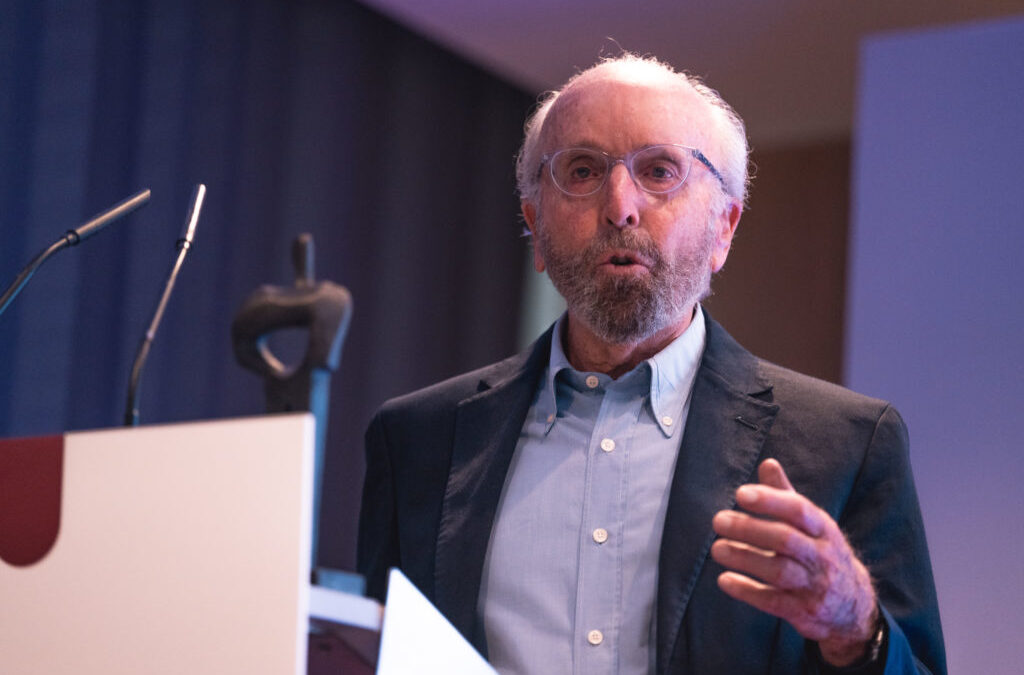
The surgeon, who headed the cardiovascular surgery department at Hospital Carlos Haya for 25 years, developed a technique to repair the tricuspid valve in 1972. It is still used around the world.
The European Association for Cardio-Thoracic Surgery (EACTS) has awarded Dr Norberto González de Vega its Lifetime Achievement Award. The prize was presented at the association’s congress in Barcelona, which brought together more than 2,000 surgeons from around the world.
González de Vega is a leading figure in cardiovascular surgery and the creator of the technique known as De Vega annuloplasty. It repairs the tricuspid valve through a straightforward, durable procedure and continues to be taught to new generations of surgeons.
He developed the technique in 1972 while working at the Jiménez Díaz Foundation in Madrid. Since then, hundreds of scientific papers and specialist books have referenced it.
Born in Granada in 1937, he moved to Madrid at the age of 19 to train at the Jiménez Díaz Foundation. His international experience included a visit to Groote Schuur Hospital in South Africa after Christiaan Barnard performed the first heart transplant there in 1967.
González de Vega later established cardiovascular surgery at Hospital Carlos Haya—now the Regional University Hospital of Málaga—and set up the department he went on to lead for 25 years. From Málaga, he helped bring national recognition to the hospital.
A technique still in use
De Vega annuloplasty is used to treat tricuspid regurgitation, particularly in non-severe functional cases. It involves reducing the valve’s ring with a double suture, supported by Teflon patches at each end, to prevent blood from flowing backwards.
The technique has been widely adopted for its simplicity, speed, safety and low cost. In October 2023, cardiovascular surgeons in Andalusia paid tribute to its creator and highlighted its use in traumatic injuries, heart transplants and paediatric patients.
The tricuspid valve controls the flow of blood from the right atrium to the right ventricle. Its three leaflets open to let blood through and close when the ventricle contracts, preventing blood from flowing back into the atrium. The blood then travels to the lungs to receive oxygen.
“It is as if the award had been given to all of us”
Speaking to SUR, González de Vega said he saw the award as recognition of the profession as a whole in Spain. “I was given this award, but it is as if it had been given to all cardiovascular surgeons in Spain,” he said, adding that their professional standard is on a par with that of the most developed countries.
The surgeon also challenged claims that Spain lacks doctors. In his view, many professionals are not treated properly and eventually leave. “When doctors are able to follow their vocation without politicians undermining it, and they feel they are treated well, they can achieve much more,” he said.
González de Vega recalled that cardiovascular surgery was not being performed at Carlos Haya when he arrived. “I came to start cardiovascular surgery,” he said. He also remembered the contrast between the original building, constructed when Málaga had around 120,000 inhabitants, and the hospital’s work today, which includes complex operations and transplants.
For years, he publicly called for a new hospital to be built opposite the Materno Infantil Hospital. “Doctors have been mistreated under both Franco’s dictatorship and democracy,” he said.
Recent Comments